
Introduction
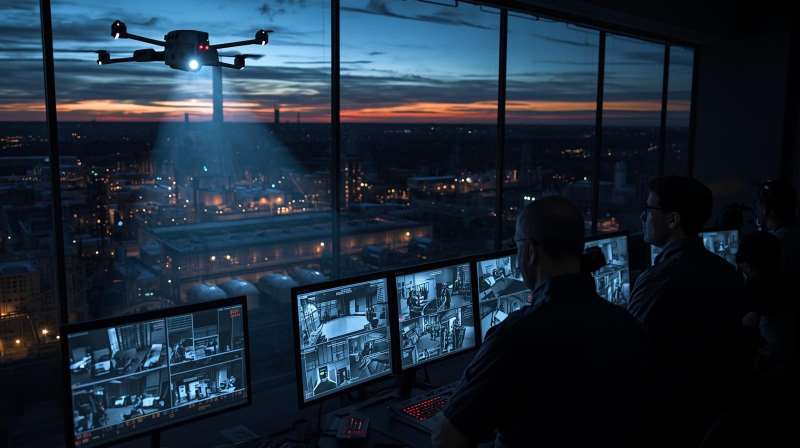
The security industry is undergoing a major transformation driven by automation, artificial intelligence, and aerial technology. Among the most impactful innovations is the rise of drone security surveillance, which is redefining how organizations monitor, protect, and respond to threats across large and complex environments.
From industrial facilities and construction sites to campuses, events, and critical infrastructure, drones are enabling faster coverage, real-time visibility, and smarter decision-making. However, drones are not replacing security guards—instead, they are becoming powerful tools that enhance the effectiveness of trained security manpower.
This blog explores how drones are revolutionizing security surveillance, covering key use cases, legal considerations, and best practices for integrating drones with on-ground security personnel.
1. What Is Drone Security Surveillance?
Drone security surveillance refers to the use of unmanned aerial vehicles (UAVs) equipped with cameras, sensors, and communication systems to monitor and protect physical spaces.
Modern security drones may include:
- High-definition and thermal cameras
- Night-vision capabilities
- GPS tracking and geo-fencing
- Live video streaming to control rooms
- AI-based motion detection
These capabilities allow drones to monitor areas that are difficult, dangerous, or time-consuming for human patrols alone.
2. Why Drones Are Changing the Security Landscape
Traditional security methods rely on:
- Static guards
- Fixed CCTV cameras
- Vehicle patrols
While effective, these systems have limitations in terms of coverage, speed, and visibility. Drones overcome many of these challenges by offering:
- Rapid aerial deployment
- Wide-area coverage in minutes
- Access to hard-to-reach zones
- Real-time situational awareness
This makes drone security surveillance a game-changer for modern security operations.
3. Key Use Cases of Drone Security Surveillance
3.1 Large Infrastructure and Industrial Facilities
Drones are ideal for securing:
- Power plants
- Refineries
- Warehouses
- Manufacturing units
- Ports and logistics hubs
They help detect perimeter breaches, monitor restricted zones, and identify safety hazards without exposing guards to risk.
Related read on securing industrial environments:
Industrial Security Services: Protecting High-Risk Facilities
3.2 Construction Sites
Construction sites face frequent issues such as:
- Equipment and material theft
- Unauthorized access after hours
- Safety compliance violations
Drones provide night-time monitoring, perimeter checks, and real-time alerts, supporting guards on the ground.
Construction Site Security: Best Practices to Prevent Theft & Damage
3.3 Event and Crowd Security
At large events, drones help with:
- Crowd density monitoring
- Traffic and parking surveillance
- Emergency response coordination
- Identifying suspicious activity
This aerial visibility allows security teams to respond faster and prevent incidents before they escalate.
3.4 Campus, Township, and Perimeter Security
Drones are increasingly used for:
- Educational campuses
- Corporate parks
- Residential townships
- Gated communities
They complement guard patrols by covering wide perimeters and blind spots that fixed cameras may miss.
3.5 Disaster Response and Emergency Situations
During fires, floods, or industrial accidents, drones help security teams by:
- Assessing damage safely
- Locating trapped individuals
- Providing live visuals to emergency responders
This capability significantly improves response time and decision-making.
4. Integrating Drones with Security Manpower Services
4.1 Drones Do Not Replace Guards—They Empower Them
A common misconception is that drones will replace security guards. In reality, drones are most effective when integrated with trained security manpower.
Guards provide:
- Human judgment and decision-making
- Physical intervention and access control
- Customer and employee interaction
- Legal accountability
Drones provide:
- Aerial visibility
- Rapid assessment
- Real-time intelligence
Together, they create a layered security model that is far more effective than either solution alone.
4.2 Coordinated Operations
In a well-integrated setup:
- Drones patrol perimeters and large zones
- Live feeds are monitored by guards or control rooms
- Alerts trigger on-ground response teams
- Guards verify, intervene, and escalate incidents
This coordination reduces response times and improves threat detection accuracy.
Learn how technology enhances guard effectiveness:
How Trained Security Personnel Can Protect Your Organization 24×7
5. Legal and Regulatory Aspects of Drone Surveillance
5.1 Compliance Is Critical
Using drones for security surveillance requires strict compliance with aviation and privacy laws. In India, for example, drone usage is regulated by the Directorate General of Civil Aviation (DGCA).
Key legal considerations include:
- Drone registration and certification
- Licensed operators or trained pilots
- Restricted and no-fly zones
- Data protection and privacy compliance
- Permission for commercial usage
Failure to comply can result in penalties and legal action.
5.2 Privacy and Ethical Concerns
Organizations must ensure:
- Drones are used only for legitimate security purposes
- Surveillance does not intrude into private areas
- Data is stored securely and accessed only by authorized personnel
Transparent policies help maintain trust with employees, residents, and visitors.
For global perspectives on drone regulations and security use cases:
https://www.securitymagazine.com
6. Challenges and Limitations of Drone Security
While powerful, drones also have limitations:
- Weather dependency (rain, wind, fog)
- Battery life and charging needs
- Skilled operators required
- Regulatory restrictions in urban areas
This is why drones should be seen as a supplementary security layer, not a standalone solution.
7. The Future of Drone Surveillance in Security
Emerging trends include:
- AI-powered object and behavior detection
- Autonomous patrol drones
- Integration with access control and alarm systems
- Centralized command centers combining CCTV, drones, and guards
As technology evolves, drones will play an increasingly strategic role in predictive and preventive security.
Conclusion
Drone security surveillance is revolutionizing the way organizations protect their assets, people, and infrastructure. By offering rapid aerial visibility and real-time intelligence, drones significantly enhance situational awareness and response capabilities.
However, the true power of drones lies in their integration with trained security manpower. When combined with professional guards, clear legal compliance, and structured protocols, drones become a force multiplier—not a replacement.
At Proman Securitech, we believe in delivering future-ready security solutions that combine advanced technology with reliable human expertise.
Contact Proman Securitech to explore how drone surveillance can be integrated into your existing security manpower services.
Pingback: sildenafil heart attack
Pingback: cialis generic india
Pingback: revatio drug classification
Pingback: remédio xenical valor
Pingback: canadian pharmacy cialis
Pingback: minoxidil shampoo reviews
Pingback: orlistat consequences
Pingback: ketoconazole for fungal infections
Pingback: terbinafine for dermatophyte nail infections
Pingback: ivermectin mechanism breakdown
Pingback: ED medication counterfeit warning
Pingback: avanafil online safety
Pingback: Sildenafil Onset Overview