
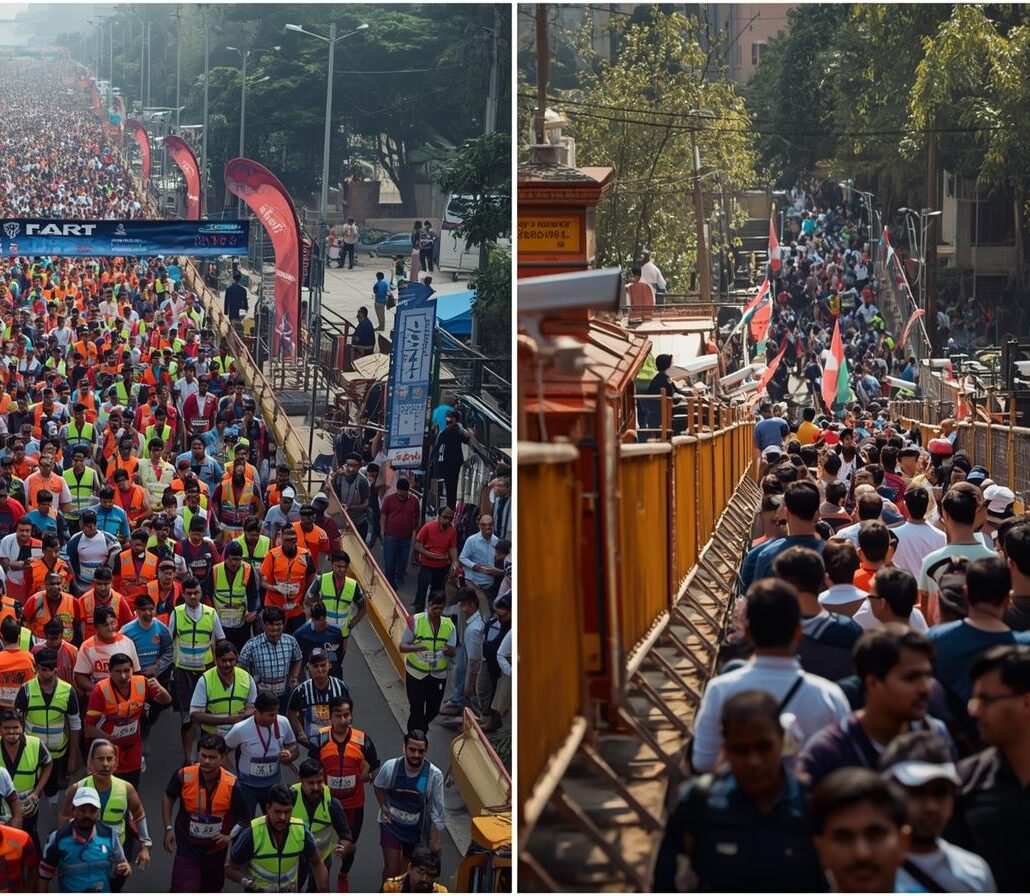
On 1 November 2025, a devastating crowd surge at the Venkateswara Swamy Temple in Kasibugga (Srikakulam district, Andhra Pradesh) claimed at least nine lives (eight women and one boy) and left over 25 devotees injured. (People.com) The incident—occurring on an Ekadashi day when thousands of devotees gathered—was a stark reminder of the risks of large gatherings without robust crowd-management and security planning. (The New Indian Express)
In this blog, we examine the indispensable role of private security in managing mega-events (trade fairs, marathons, large religious gatherings), identify failures in the Kasibugga tragedy, and outline global best practices adapted to the Indian context that private security firms can adopt to prevent such tragedies.
1. What Happened at Kasibugga: A Case Study in What Can Go Wrong
- At the Venkateswara Swamy Temple in Kasibugga, the reported capacity was around 3,000, yet on that Ekadashi day about 25,000 devotees had converged. (People.com)
- Survivors and investigators pointed to a narrow single entry/exit gate, simultaneous inward and outward flows, a weak railing/grill structure that collapsed, and absence of a separate exit route or adequate crowd flow control. (The New Indian Express)
- The temple was privately built and managed; authorities say the organisers did not inform police or coordinate with government agencies in advance about the crowd surge. (The New Indian Express)
- The aftermath: a joint departmental panel has been constituted to inspect safety at smaller and privately managed temples. (The Times of India)
Key Lessons: Without proper crowd planning, separation of flows (entry vs exit), sturdy infrastructure, communication protocols and security oversight, large gatherings—even religious ones—can turn tragic.
2. Why Private Security Matters in Mega Events & Large Gatherings
When events such as trade fairs, marathons or large religious gatherings take place, the role of professional private security agencies becomes critical:
- Scalable manpower & specialised training: Private security providers can supply trained guards, crowd-marshals, access control teams tailored to event size and nature.
- Technology integration: Use of CCTV, crowd-density sensors, mobile incident reporting apps, real-time communication enables faster response and proactive intervention.
- Crowd flow design & monitoring: Private security with event planners can design ingress/egress routes, barrier placements, alternate routes, emergency exits.
- Interface with public authorities: Private agencies act as bridges between event organisers and law enforcement, traffic police, medical/emergency services.
- Contractual accountability: Clear service-level agreements (SLAs) in private security contracts can ensure defined responsibilities, metrics for crowd control, incident reporting, evacuation drills.
In short: private security is not just “guarding” but active event-safety management partner.
3. Applying Lessons to India’s Event Scenario: Global Best Practices You Can Adopt
Here are best practices—tailored to Indian conditions—that private security firms and event organisers should embed:
A. Pre-Event Risk Assessment & Coordination
- Crowd estimation & scenario planning: Use historical turnout, social media signals, regional festivals, public holidays to estimate surge; plan for worst-case (150–200% of expected).
- Venue inspection: Check structural integrity of stairs, railings, barriers; ensure separate entry & exit paths; sufficient width; durable materials. (Kasibugga lacked these).
- Coordination with authorities: Inform and integrate with police, local municipality, fire brigade, medical/trauma unit, traffic control.
- Private security agency involvement from planning stage: Provide layout recommendations, marshal placement, emergency flow routes, communication channels.
- Mock drills / table-top exercises: Simulate emergencies (stampede risk, route blockage, medical emergency, VIP intrusion) well in advance.
B. Crowd Flow & Infrastructure Management
- Separate ingress and egress: Never a single gate for both entry and exit; avoid counter-flows. Kasibugga collapse triggered when exit and entry flows collided.
- Clear signage & barrier systems: Use colour-coded pathways, barricades guiding movement; crowd-density sensors in very large events.
- Capacity management: When capacity reached, stop entry; mobile-based counters, turnstiles, scanning systems.
- Structural safety: Ensure stairs, railings, handrails are built to standard; avoid weak metal grills or short-foundation barricades.
- Dedicated emergency exit routes: In crowd panic, fast evacuation needs unobstructed paths; marshal guidance and functional emergency exits are essential.
C. On-Day Implementation & Monitoring
- Trained marshals & guards: Equipped with radios, first-aid kits, trained in crowd psychology, able to spot early warning signs (crowd compression, sudden pressure, jam-ups).
- Central Command & Control Room: Real-time feed of CCTV, marshals’ status, medical units, police liaison; private security must act promptly on alerts.
- Mobile incident-reporting system: Guards report via apps; flag overcrowded zones; request reinforcement; liaise with traffic/medical.
- Communication with crowd: PA systems, multilingual announcements, visible staff directing flows; accessible information points.
- Emergency medical readiness: Strategically placed first-aid stations, stretcher teams; private security monitors quickly escalate to ambulance/hospital.
- Incident logs and debrief during event: Track near-misses, blocked paths, delays; adjust while event ongoing.
D. Post-Event Review & Continuous Improvement
- Incident debrief: What happened, root causes, marshal feedback, structural failures, crowd responses.
- Data analytics: Footfall patterns, peak hours, flow bottlenecks, resource deployment vs outcome.
- Training refreshers: Based on lessons, update training modules for guards, marshals.
- Infrastructure upgrades: Repair or redesign weak points, update barrier systems, upgrade monitoring tech.
- Accountability & reporting: Private security agencies provide full report to organisers/police; set KPIs for next event.
4. The Indian Context: Why These Measures Are Urgently Required
- India sees frequent crowd-surge incidents at religious gatherings, public festivals, large sporting/events. (The Indian Express)
- Many venues are private, or not fully in the public safety regime, which means coordination and oversight can be weaker (as in Kasibugga).
- Cultural, language, climatic, infrastructural variability: India has massive regional differences—marathons in metros, trade fairs in convention centres, temple events in rural areas. Private security must adapt.
- Rapid surge potential: Social media triggers, festival announcements, special days (Ekadashi) can cause unexpected turnout beyond estimates.
- Infrastructure constraints: Older buildings, narrow stairs, inadequate exit routes are common in Indian venues. The Kasibugga tragedy underlines this.
- Public-private coordination gaps: Often organisers rely solely on local agency permissions but fail to integrate full event-safety plan with private security and police.
5. Role of Private Security in Trade Fairs, Marathons & Large Gatherings
Trade Fairs
- Large kitchen: Exhibitor booths, high-value assets, thousands of visitors over days.
- Key private security roles: Access control (staff vs visitor), badge verification, CCTV monitoring, patrol teams, asset escort, emergency response.
- Crowd management: Exhibitor hours, visitor influx peaks, VIP entries—private-security must coordinate with event management and police.
Marathons / Large Sporting Events
- Route spans city streets, large participation, spectators, start/finish bottlenecks.
- Private security tasks: Route marshals, checkpoint monitoring, spectator zone control, access for emergency vehicles, liaise with traffic police, medical stations.
- Use of mobile apps, GPS tracking of crowd clusters, dynamic resource deployment.
Large Religious Gatherings / Cultural Events
- Many devotees, varied age groups, surge potential, unpredictable behaviours.
- Private security must manage: queue systems, darshan flows, access restrictions, emergency evacuation, first-aid stations.
- Integration with temple/organiser logistics, police, fire department.
In all scenarios, private security is part of the event-safety ecosystem—and when well-embedded, can prevent incidents like Kasibugga.
Q&A
Q1: How early should a private security agency be engaged for large events?
A1: As early as the risk-assessment phase, ideally months ahead, so that layout, capacities, tech deployment, scenario drills, coordination with police/traffic authorities are planned.
Q2: What are common failures that trigger crushes, and how does private security counter them?
A2: Common failures: poor flow separation (entry & exit mixing), underestimated crowd size, weak infrastructure (rails/stairs), lack of emergency exits, inadequate monitoring. Private security counters by designing flows, installing barriers, real-time monitoring, marshals spotting choke points, having evacuation plans.
Q3: Can private security alone manage event-safety without police involvement?
A3: No—while private security is vital, coordination with public authorities (police, traffic, fire, medical) is essential. Responsibilities must be clearly defined. For example, in Kasibugga the organisers did not liaise with police in advance. (The New Indian Express)
Q4: How do we ensure infrastructure is safe for large crowds?
A4: Conduct engineering inspections of stairs/railings, ensure barrier foundations meet load standards, provide sufficiently wide paths, install separate entry/exit gates, test load under controlled conditions. Private security firms should insist organisers engage structural engineers.
Q5: What real-time tech tools help private security in crowd management?
A5: Crowd-density sensors, CCTV analytics (crowd behaviour/flow), incident-reporting mobile apps, GPS tracking of marshals, PA systems for mass announcements, digital turnstiles, visitor-counting systems.
Conclusion
The tragedy at the Venkateswara Swamy Temple in Kasibugga on 1 November 2025 is a painful reminder that large gatherings—even for sacred purposes—carry significant risk when crowd management systems and infrastructure are inadequate. Private security agencies are not optional extras, but key stakeholders in safeguarding mega-events, trade fairs, marathons and religious congregations.
By adopting global-standard best practices—early engagement, risk assessment, flow design, technology integration, trained marshals, command-control rooms, real-time monitoring, post-event review—and tailoring them to India’s unique conditions, private security can help ensure that future large gatherings do not become tragedies.
When planning your next large-scale event:
- Engage your private security agency early.
- Ensure entry and exit flows are separated and infrastructure is robust.
- Use technology and monitoring in real time.
- Coordinate fully with police, traffic, medical and municipal services.
- Conduct post-event review and improvement for next time.
Visit our blog for more insights: www.promansecuritech.com/blog
- Explore our event-security services: www.promansecuritech.com/blog/event-security-services
External Links:
- “At least 9 dead, dozens injured in crowd surge at Hindu temple in southern India” — AP News. (AP News)
- “Narrow gate, weak grill, and no crowd control: Survivors recall horror of Andhra temple stampede” — The New Indian Express. (The New Indian Express)
- “A P Venkateswara Temple Stampede: Why stampedes frequently tend to unfold in India” — The Indian Express. (The Indian Express)